Skip to content

A beautiful, healthy lawn can transform your garden, making it a more inviting place to relax, entertain guests and enjoy time outdoors. However, before ordering new turf, there is one important step to get right: measuring your garden accurately.
If you order too little, you could face delays while waiting for extra turf to arrive. Order too much, and you may spend money on grass you do not need. Fortunately, measuring your garden is straightforward once you understand a few simple calculations.
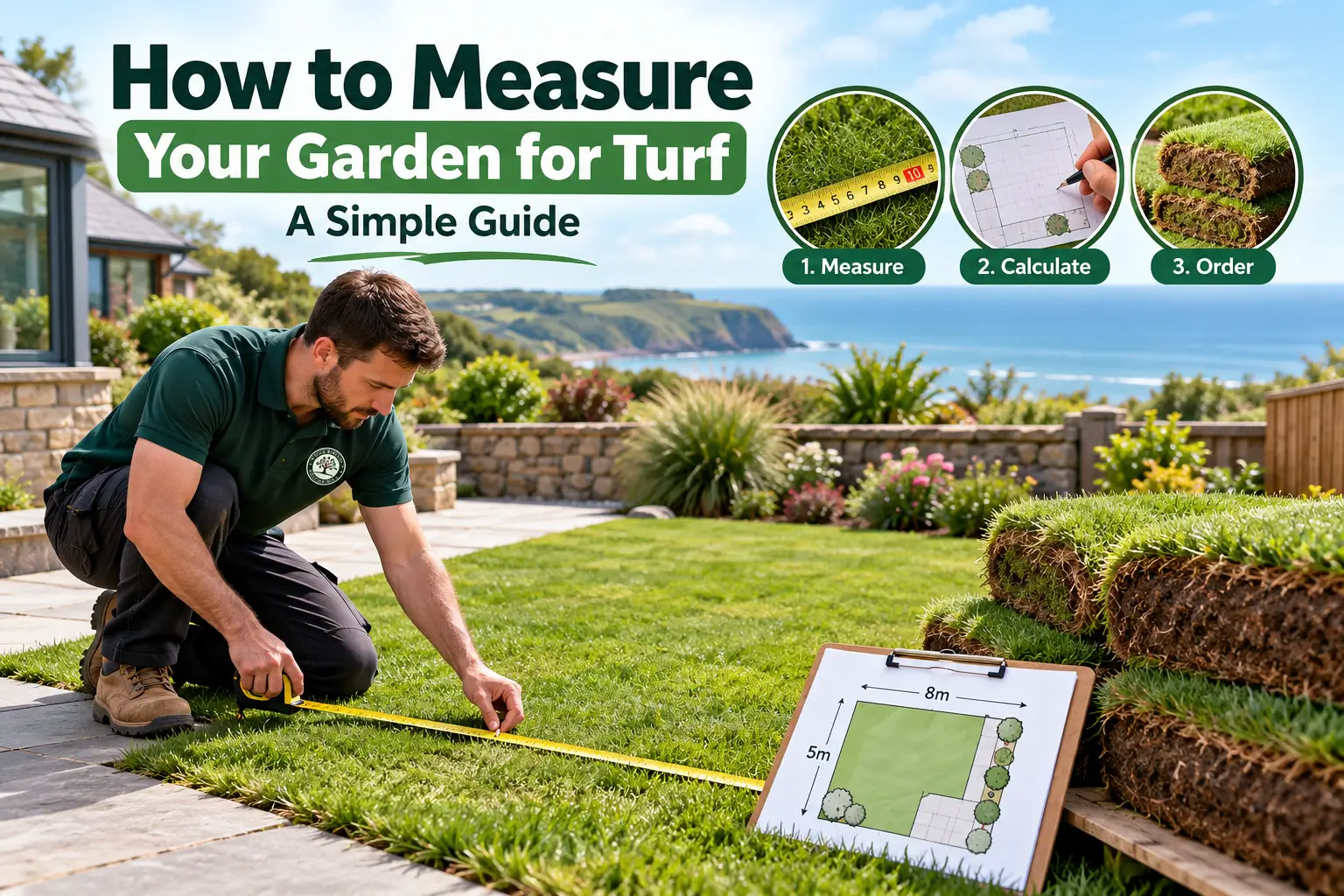
In this guide, we explain How to Measure Your Garden for Turf, including how to calculate square metres, measure irregular shapes, allow for waste and prepare for a successful new lawn. Whether you have a small garden in Newquay or a larger outdoor space in Truro, these practical steps will help you plan with confidence.
Why Is Accurate Garden Measurement Important?
Turf is generally ordered by area, measured in square metres (m²). Knowing the size of your lawn helps you estimate how much turf to buy and plan your landscaping budget.
Accurate measurements are also useful when calculating the amount of topsoil and other materials your project may require.
There are three main benefits:
- Better cost control: You can estimate material requirements before requesting a quotation.
- Less waste: Ordering an appropriate quantity reduces unnecessary offcuts and unused turf.
- Smoother installation: Having enough turf available helps the installation proceed without avoidable interruptions.
The Royal Horticultural Society recommends measuring the proposed lawn and checking turf dimensions before purchasing. You can read its practical advice in the RHS guide to laying turf.
What Tools Do You Need to Measure Your Garden?
You do not need specialist equipment to measure a typical garden. A few basic tools will usually be enough.
Before starting, gather:
- A tape measure, preferably a long one suitable for outdoor measurements.
- A notepad and pencil, or a phone for recording dimensions.
- Garden pegs or markers for identifying boundaries.
- A calculator for working out the total area.
- Graph paper, if your garden has several sections or an unusual shape.
For larger gardens, a laser measure can be useful, although you should check readings carefully around obstacles and uneven ground.
Measure in metres wherever possible. This keeps your calculations consistent and makes it easier to order turf by square metre.
How to Measure Your Garden for Turf Step by Step
The easiest approach is to divide your garden into manageable sections, measure each one and calculate the areas separately.
Step 1: Sketch Your Garden Layout
Start by drawing a simple outline of the area you want to cover with turf. It does not need to be perfectly to scale.
Mark any features that will not be grassed, such as patios, sheds, planting beds, paths and permanent structures.
If you plan to change the garden layout as part of a wider project, make sure your sketch reflects the final design rather than the existing arrangement.
Step 2: Measure the Length and Width
For a rectangular or square lawn, measure the longest side and then the width at a right angle to it.
Measure the grassed area itself rather than the entire garden if parts of the space will remain paved or planted.
For example, imagine your proposed lawn measures:
- Length: 8 metres
- Width: 5 metres
Multiply the two measurements:
8 × 5 = 40 m²
You will need to cover approximately 40 square metres, before allowing for any extra turf needed for cutting and fitting.
Step 3: Measure Around Fixed Features
If a tree, flower bed or paved section sits within the proposed lawn area, measure the space that will actually receive turf.
For example, if your lawn covers 40 m² but a rectangular flower bed occupies 2 m², subtract the flower bed:
40 − 2 = 38 m²
Your revised lawn area is 38 m².
For circular features, measure the diameter across the centre and divide it by two to find the radius. The area can then be calculated using π × radius × radius. For a circle with a radius of 0.5 metres, the area is approximately 0.79 m².
Remember to measure features accurately. Small differences can add up when a garden contains several beds, trees or paved areas.
How to Measure an Irregularly Shaped Garden
Not every garden is a perfect rectangle. Many Cornish gardens include curved borders, angled boundaries, narrow passages and changes in layout.
The simplest solution is to split the space into smaller shapes, calculate each area and add the results together.
L-Shaped Gardens
An L-shaped lawn can usually be divided into two rectangles.
Suppose the first rectangle measures 6 metres by 4 metres, while the second measures 3 metres by 2 metres.
- First section: 6 × 4 = 24 m²
- Second section: 3 × 2 = 6 m²
- Total area: 24 + 6 = 30 m²
The combined lawn area is 30 m².
Make sure the two sections do not overlap. If they do, the overlapping area could be counted twice.
Triangular Sections
For a triangular lawn section, measure the base and the perpendicular height.
Use this formula:
Base × height ÷ 2
For example, a triangle with a base of 4 metres and a height of 3 metres has an area of 6 m².
Curved Lawn Edges
Curved gardens require a little more care because the boundary does not follow a straight line.
You can estimate the area by dividing the space into rectangles, triangles and smaller sections. For a gently curved edge, this can provide a useful planning estimate.
However, if the shape is complicated or the lawn is large, professional measurement can help reduce the risk of ordering the wrong quantity.
How Much Extra Turf Should You Order?
Once you have calculated the lawn area, consider whether you need a small allowance for trimming and fitting.
For a straightforward rectangular lawn, around 5% extra may be a reasonable initial planning allowance. More complicated gardens with curves, narrow sections or several obstacles may require a larger allowance, depending on the layout and installation method.
For example, if your measured lawn is 40 m² and you allow 5% extra:
40 × 0.05 = 2 m²
40 + 2 = 42 m² of turf
This is an estimate rather than a universal rule. Check the turf supplier’s recommendations and discuss the layout with your installer before placing an order.
Avoid ordering a large surplus without a clear reason. Fresh turf needs to be laid promptly, so unnecessary quantities can create additional cost and handling difficulties.
Common Garden Measuring Mistakes to Avoid
Even a simple measurement can go wrong if you rush the process. Watch out for these common mistakes:
- Measuring the whole garden: Include only the area that will receive turf, not patios, paths or planting beds.
- Forgetting awkward corners: Narrow strips and small sections still contribute to the total area.
- Using inconsistent units: Convert all measurements to metres before calculating square metres.
- Double-counting sections: Check that your separate shapes do not overlap.
- Ignoring the final design: If you are changing borders or adding a patio, measure the planned lawn after those changes.
- Ordering without checking turf sizes: Confirm how your supplier sells and delivers turf, including pack sizes and minimum quantities.
Taking a little extra time at this stage can prevent avoidable problems later.
Does Garden Preparation Affect Turf Measurements?
Measuring the area is only one part of planning a new lawn. The condition of the ground also matters.
Before installation, the site may need clearing, levelling, weed removal or soil improvement. These tasks can affect the final shape and usable lawn area, particularly where existing borders or uneven ground need attention.
The RHS advice on preparing and laying turf explains why soil preparation is important for successful establishment. Newly laid turf also needs suitable conditions and watering while its roots establish.
In Cornwall, garden conditions can vary considerably. A sloping garden, exposed site or area with drainage problems may need additional preparation before turf is laid.
If your garden needs more than a simple lawn replacement, explore New Turf Installation in Cornwall to learn more about professional installation options.
Planning Your Turf Installation in Cornwall
Once you know the approximate area, you can begin planning the practical details of your project.
Consider the following questions:
- Is the existing lawn being replaced, or is this a completely new area?
- Does the ground need levelling or clearing?
- Are there drainage issues that should be addressed first?
- Will you need to alter any borders, paths or garden features?
- Can the turf be delivered and laid promptly?
These details help you move from a basic measurement to a realistic installation plan.
If you are comparing options, our article on Garden Landscaping vs Garden Renovation: Which Is Right? explains how different project scopes can influence the work involved.
You may also find How to Manage an Overgrown Garden Without Starting Again useful if your existing outdoor space needs attention before new turf can be installed.
Need Professional Help with Your New Lawn?
Measuring your garden is a useful starting point, but getting the finished lawn right also depends on ground preparation, turf selection and careful installation.
Laingscape provides gardening and landscaping services across Cornwall, with more than 20 years of experience. If you are planning a new lawn and would prefer professional support, we can help you discuss the work required and request a free, no-obligation quotation.
Our team can help you plan your project around the garden’s layout, existing features and intended use.
Explore our Turf Laying in Truro and Turf Laying in Newquay services, or find out more about Turf Installation in St Austell.
You can also browse our full range of gardening and landscaping services, learn more about Laingscape, or contact our team to discuss your plans.
For additional information about the business, visit our Google Business Profile or Laingscape’s Google listing. You can also check our Trustpilot reviews before deciding whether our services are right for your project. Always review current feedback and the details relevant to the work you need.
Conclusion: Measure Carefully for a Better Lawn
Understanding How to Measure Your Garden for Turf helps you estimate the right quantity, manage your budget and prepare for a smoother installation.
Start by sketching the area, measuring each section in metres and calculating the square metres. Subtract permanent features, divide irregular shapes into simpler sections and allow a sensible amount for trimming where necessary.
Most importantly, remember that accurate measurements are only the beginning. Good ground preparation and appropriate aftercare are essential for helping your new lawn establish successfully.
If you are planning a new lawn in Cornwall, Laingscape can help you take the next step. Contact our team on +44 7988 759149 or email oliver@laingscape.co.uk to discuss your garden and request a free, no-obligation quotation.
Frequently Asked Questions
1. How do I calculate the square metres of my garden?
Measure the length and width in metres, then multiply them. For example, an area measuring 8 metres by 5 metres is 40 m². For irregular gardens, calculate smaller sections separately and add them together.
2. How much turf do I need for a 40 m² garden?
You need enough turf to cover 40 m², plus any suitable allowance for trimming and fitting. A 5% planning allowance would bring the estimated order to 42 m², although the appropriate amount depends on the shape and installation requirements.
3. Should I subtract flower beds and patios when measuring?
Yes. If these features will remain in place, subtract their area from the total space. This gives you a more accurate estimate of the area that actually needs turf.
4. How do I measure an L-shaped garden for turf?
Divide the garden into two non-overlapping rectangles. Calculate each rectangle by multiplying its length by its width, then add the two results to find the total lawn area.
5. How much extra turf should I allow for waste?
Around 5% can be a reasonable starting allowance for a simple rectangular lawn. Gardens with curves, angled edges or multiple obstacles may need more. Ask your turf supplier or installer to confirm the appropriate quantity.
6. Can I measure my garden in feet instead of metres?
Yes, but convert your measurements to metres before calculating the area if you are ordering turf by square metre. Alternatively, calculate the area in square feet and convert it to square metres. One square metre is approximately 10.764 square feet.
7. Is professional garden measurement necessary?
Not always. Most straightforward lawns can be measured with a tape measure and calculator. Professional help may be useful for larger gardens, complex boundaries, steep slopes or projects involving substantial ground preparation.
8. Does the garden need to be level before turf is installed?
The ground should be suitably prepared and levelled for the intended lawn. Significant bumps, hollows, poor drainage or uneven ground may need attention before installation. The right preparation depends on the existing soil and site conditions.
9. When should I order turf after measuring my garden?
Order turf when you have confirmed the area, quantity, delivery arrangements and ground preparation. Fresh turf should generally be laid promptly after delivery, so coordinate delivery with the installation date rather than ordering too far in advance.