Skip to content
A healthy hedge can provide privacy, shelter, structure and a natural boundary around your garden. But when growth gets out of control, it can become difficult to know whether a normal trim will solve the problem or whether the hedge needs a much more substantial reduction.
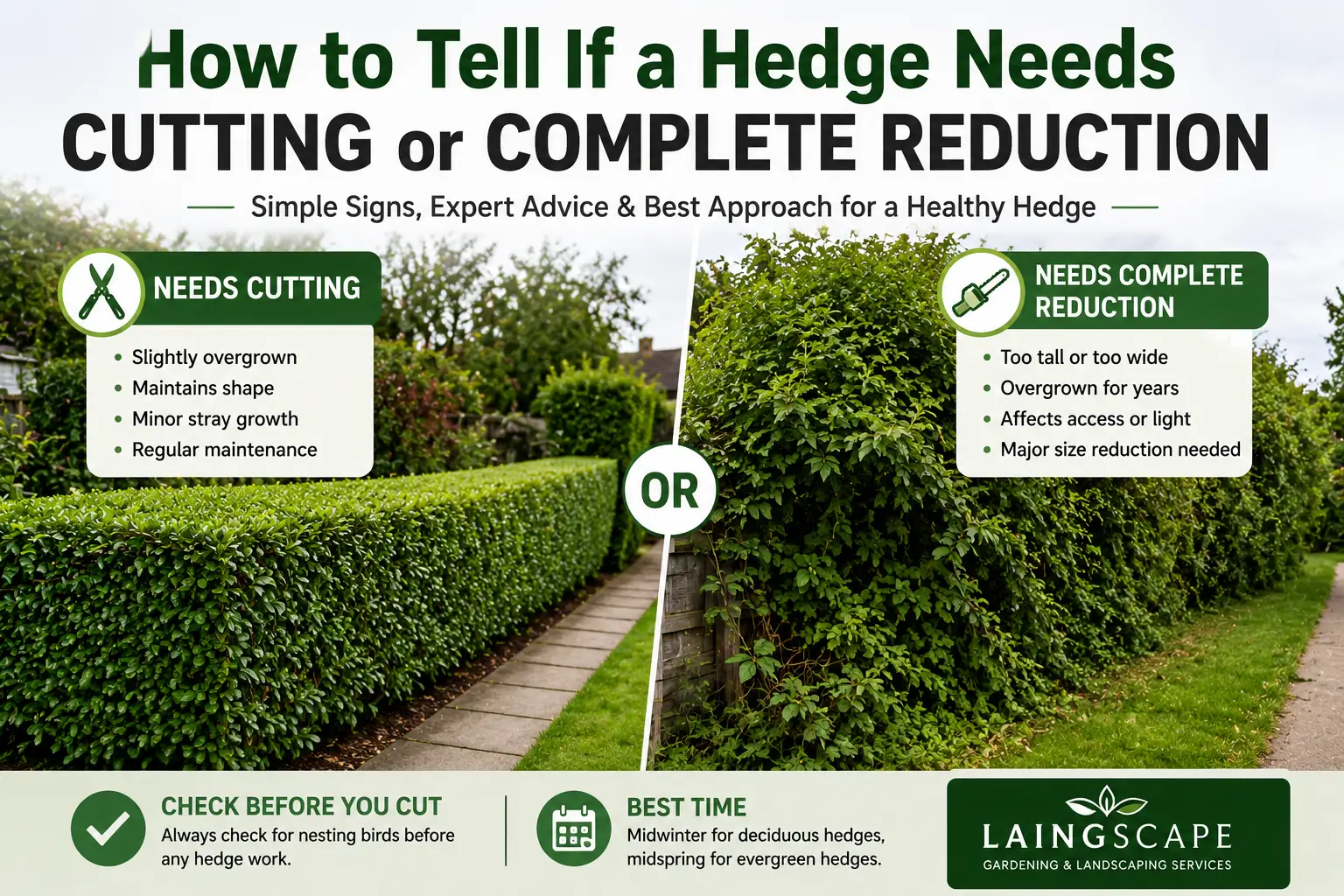
This is where understanding How to Tell If a Hedge Needs Cutting or Complete Reduction becomes important. Cutting removes relatively small amounts of new growth to maintain the hedge’s shape, while reduction involves taking considerably more material away to bring an oversized hedge back to a manageable size.
The right approach depends on the hedge species, its age, current condition, size and how severely it has been neglected. Cutting too hard at the wrong time can also leave some plants struggling to recover.
For Cornwall homeowners, regular care can be particularly useful because gardens experience varied weather, rainfall and growing conditions throughout the year.
What Is the Difference Between Cutting and Reduction?
Although the terms are sometimes used interchangeably, routine hedge cutting and hedge reduction are quite different jobs.
Hedge cutting is generally maintenance. It involves removing recent growth to keep an established hedge at its preferred height, width and shape.
Hedge reduction is more substantial. It involves reducing the overall dimensions of a hedge that has become too large, too wide, too tall or difficult to manage.
The Royal Horticultural Society explains that established hedges are normally maintained through regular trimming, while overgrown hedges may require renovation or reduction.
A simple rule is:
- Small amount of new growth = routine cutting
- Noticeably oversized hedge = reduction may be needed
- Very large or neglected hedge = professional assessment is sensible
- Severe reduction = may need to be carried out gradually
Signs Your Hedge Only Needs Cutting
Knowing How to Tell If a Hedge Needs Cutting or Complete Reduction starts with looking at how much growth has appeared since its last trim.
If the hedge is still roughly the right size but has become untidy, a standard cut may be all that’s required.
Look for signs such as:
- New shoots extending beyond the established shape
- Uneven sides
- Stray branches
- A slightly overgrown top
- Growth beginning to encroach on paths
- Small amounts of foliage extending beyond the boundary
For established formal hedges, regular trimming helps maintain density and shape. The RHS notes that informal hedges may require less frequent trimming, while formal hedges can require cutting more than once a year depending on the plant.
If the hedge is otherwise healthy and hasn’t dramatically exceeded its intended dimensions, there’s usually no reason to remove large amounts of growth unnecessarily.
Signs Your Hedge May Need Reduction
A hedge that has become significantly larger than intended may need more than a routine trim.
Some common warning signs include:
It Has Become Too Tall
If the hedge has grown well above the height you originally wanted, simply trimming the latest growth may not make enough difference.
It Has Become Too Wide
A hedge can gradually expand into a garden, pathway or neighbouring area. If repeated light trimming no longer keeps it within its intended space, reduction may be appropriate.
The Base Is Becoming Shaded
Very wide hedges can create dense shade beneath themselves, affecting nearby plants and making the garden feel smaller.
It Has Not Been Maintained for Several Years
A neglected hedge may have accumulated substantial older wood and become much harder to manage.
It Is Affecting Access or Views
Branches extending over paths, driveways or access areas can become inconvenient and potentially hazardous.
These are strong indicators that it’s time to consider whether ordinary maintenance is still enough.
How to Tell If a Hedge Needs Cutting or Complete Reduction
When deciding How to Tell If a Hedge Needs Cutting or Complete Reduction, consider the hedge’s current size rather than simply how untidy it looks.
Imagine a hedge that should be approximately 1.8 metres high but has gradually reached 2.5 metres. Removing only the newest growth might make it look tidier temporarily, but it won’t solve the underlying size problem.
A reduction brings the hedge closer to its intended dimensions.
However, the species matters enormously. Some hedging plants can respond well to hard renovation, while others do not regenerate effectively from old wood.
The RHS states that many hedges, including beech, hawthorn, holly, hornbeam and yew, can tolerate significant reduction, while most conifers do not respond well to renovation.
That is why identifying the plant before carrying out drastic pruning is essential.
Hedge Type Can Change the Right Approach
Not every hedge should be treated in the same way.
Deciduous Hedges
Many deciduous species can respond well to renovation when carried out at an appropriate time. Some may tolerate substantial reductions and produce new growth from older wood.
Evergreen Hedges
Evergreen plants require more careful consideration because different species respond differently to hard pruning.
Conifer Hedges
This is particularly important with conifers. Many common conifers will not reliably produce new shoots from old, bare wood. The RHS advises that most conifers, with yew being an exception, do not respond well to renovation.
If an old conifer hedge has become significantly oversized and bare inside, replacing it may sometimes be more practical than attempting a severe reduction.
When Should a Hedge Be Reduced?
Timing matters when carrying out substantial hedge work.
The ideal timing varies according to the plant species. The RHS generally recommends midwinter renovation for deciduous hedges and mid-spring renovation for evergreen hedges.
However, there is another important consideration: wildlife.
Before cutting or reducing a hedge, always check carefully for active bird nests. The RHS advises avoiding hedge work when nesting birds are present, while GOV.UK notes that work must not harm nesting birds or destroy their nests.
The main nesting and breeding period is commonly considered to run from March to August, but active nests can occur outside those dates.
If you find an active nest, stop and seek appropriate advice before continuing.
Can an Extremely Overgrown Hedge Be Reduced in One Go?
Sometimes, but not always.
For many suitable hedge species, moderate renovation may be possible in a single stage. However, very drastic reductions can place considerable stress on the plant.
The RHS recommends that where more than around 50% of a suitable hedge’s height or width needs to be removed, gradual renovation over two or three years can be preferable.
A staged approach can involve reducing one side first, allowing the plant time to recover, then addressing the other side and eventually reducing the height.
This is particularly useful when the hedge is valuable, mature or providing important privacy.
Why Professional Hedge Cutting Can Be Worthwhile
Tall and heavily overgrown hedges can be difficult to manage safely.
Powered hedge trimmers, ladders and cutting equipment can become hazardous when working at height or around uneven ground. Large hedges can also produce a substantial amount of green waste.
A professional service can assess:
- Hedge species
- Overall condition
- Required reduction
- Safe working height
- Suitable pruning approach
- Access requirements
- Waste removal
- Future maintenance needs
Professional assessment is especially valuable when you aren’t sure whether a hedge needs routine cutting or substantial renovation.
How Regular Cutting Prevents Major Reductions
One of the simplest ways to avoid drastic hedge work is to maintain the hedge consistently.
Regular maintenance keeps growth within manageable limits and reduces the need for aggressive pruning later.
A sensible routine can include:
- Checking growth throughout the year
- Trimming appropriate species at suitable times
- Keeping the hedge at a manageable size
- Removing damaged growth
- Watching for bare or unhealthy sections
- Inspecting for nesting birds before work
The RHS notes that regular trimming helps keep established hedges dense, neat and within their intended bounds.
In other words, preventative maintenance can often be much easier than trying to recover a hedge that has been neglected for years.
Professional Hedge Cutting in Cornwall
If you’re still unsure How to Tell If a Hedge Needs Cutting or Complete Reduction, Laingscape can help assess the situation.
With more than 20 years of gardening and landscaping experience, we provide professional hedge cutting, reduction and wider garden maintenance services across Cornwall.
Our work can include:
- Hedge trimming
- Hedge reduction
- Seasonal pruning
- Overgrown garden clearance
- Weed control
- Lawn care
- General garden maintenance
We work across Truro, Newquay, Falmouth, St Austell, St Mawes and surrounding Mid Cornwall areas.
You can explore our Hedge Cutting Services in Cornwall and Garden Maintenance Cornwall pages for more information about our services.
Get Professional Help With Your Hedge
If your hedge has become too tall, too wide or difficult to manage, don’t wait until the problem becomes harder to solve.
Laingscape can assess your hedge and help determine whether it needs routine trimming, a more substantial reduction or a longer-term maintenance plan.
With more than 20 years of practical gardening and landscaping experience, we provide a straightforward local service focused on doing the right work for the plant and the property.
Phone: 07988 759149
Email: oliver@laingscape.co.uk
Address: Four Winds, Zelah, Truro TR4 9JD, United Kingdom
If you’re planning broader garden improvements, you can also link this section to your relevant Garden Maintenance, Landscaping, Garden Clearance and Contact pages.
Conclusion
Understanding How to Tell If a Hedge Needs Cutting or Complete Reduction can help you avoid unnecessary hard pruning and keep your garden boundary healthy and manageable.
If your hedge has only produced a small amount of new growth, routine cutting will probably be enough. If it has become substantially taller or wider than intended, reduction may be more appropriate.
However, the correct approach depends on the hedge species, its condition and how much needs to be removed. Conifers in particular require caution because many do not regenerate well from old wood.
Timing and wildlife protection are also essential considerations. Always check carefully for active bird nests before starting hedge work.
With regular maintenance and the right pruning approach, many hedges can remain attractive, dense and manageable for years. If you’re uncertain about the condition of your hedge, getting professional advice can help you choose the safest and most practical solution.
You can also explore our Contact page or relevant service pages to find out more about how we can help maintain and improve your outdoor space. You can also see examples of our work and customer experiences through our Google Business Profile and social media presence.
Frequently Asked Questions
How do I know if my hedge needs cutting?
If the hedge has mainly produced new shoots and is still close to its intended height and width, routine cutting is usually appropriate. Uneven sides, stray growth and a slightly untidy top are common signs.
How do I know if my hedge needs complete reduction?
A hedge may need substantial reduction when it has become significantly too tall or wide and routine trimming no longer brings it back to a manageable size.
Can every hedge be heavily reduced?
No. Hedge species respond differently to hard pruning. Many deciduous species can tolerate significant renovation, while most conifers do not regenerate well from old wood.
Can an overgrown hedge be reduced by half?
Some suitable hedge species can tolerate reductions of around half their height or width, but more drastic renovation may be better carried out gradually over several years.
When is the best time to reduce a hedge?
Timing depends on the species. The RHS recommends midwinter for deciduous hedge renovation and mid-spring for evergreen renovation, subject to wildlife considerations.
Can I cut a hedge when birds are nesting?
You should not damage or destroy an active wild bird nest. Always inspect the hedge before work and postpone cutting if an active nest is present.
How often should a hedge be trimmed?
It depends on the species and desired appearance. Informal hedges may need roughly annual maintenance, while formal hedges can require trimming once, twice or several times during the growing season.
What happens if an overgrown hedge is left untreated?
It can continue expanding into paths, gardens or neighbouring areas, become increasingly difficult to manage and potentially require more substantial renovation later.
Should I reduce a tall conifer hedge?
Extra care is needed. Many conifers do not reliably reshoot from old wood, so severe reduction can leave permanent bare areas. Professional assessment is advisable before undertaking major work.
Can Laingscape help with hedge reduction in Cornwall?
Yes. Laingscape provides hedge cutting, reduction and garden maintenance services across Cornwall, including Truro, Newquay, Falmouth, St Austell, St Mawes and surrounding areas.