Skip to content
A garden makeover can quickly become expensive when decisions are made in the wrong order. New paving may need to be lifted to solve drainage problems, plants can be purchased before the soil is ready, and attractive features can take priority over improvements that actually make the garden work.
The good news is that creating a better garden does not always require a huge budget. Careful planning, realistic priorities and a clear understanding of what you already have can prevent unnecessary spending.
If you are wondering How to Plan a Garden Makeover Without Wasting Money, start with the garden itself rather than a shopping list. Look at what needs improving, what can be retained and which changes will make the biggest difference.
Start by Understanding Your Existing Garden
Before ordering materials or booking landscaping work, spend time assessing what is already there.
Look at the lawn, borders, fencing, paving, planting, drainage, soil, access and existing garden structures. You may discover that some features only need maintenance or repair rather than complete replacement.
For example, an established shrub can provide structure and privacy that would be expensive to recreate. Likewise, an existing patio may only need cleaning, repairs or a small redesign rather than removal.
The RHS recommends taking time to understand an established garden before making major changes because retaining plants and reworking existing features can help reduce costs.
For ongoing garden care, you can explore Garden Maintenance in Cornwall.
Create a Practical Garden Plan Before Spending
One of the easiest ways to waste money is to start buying materials before deciding exactly what the garden needs.
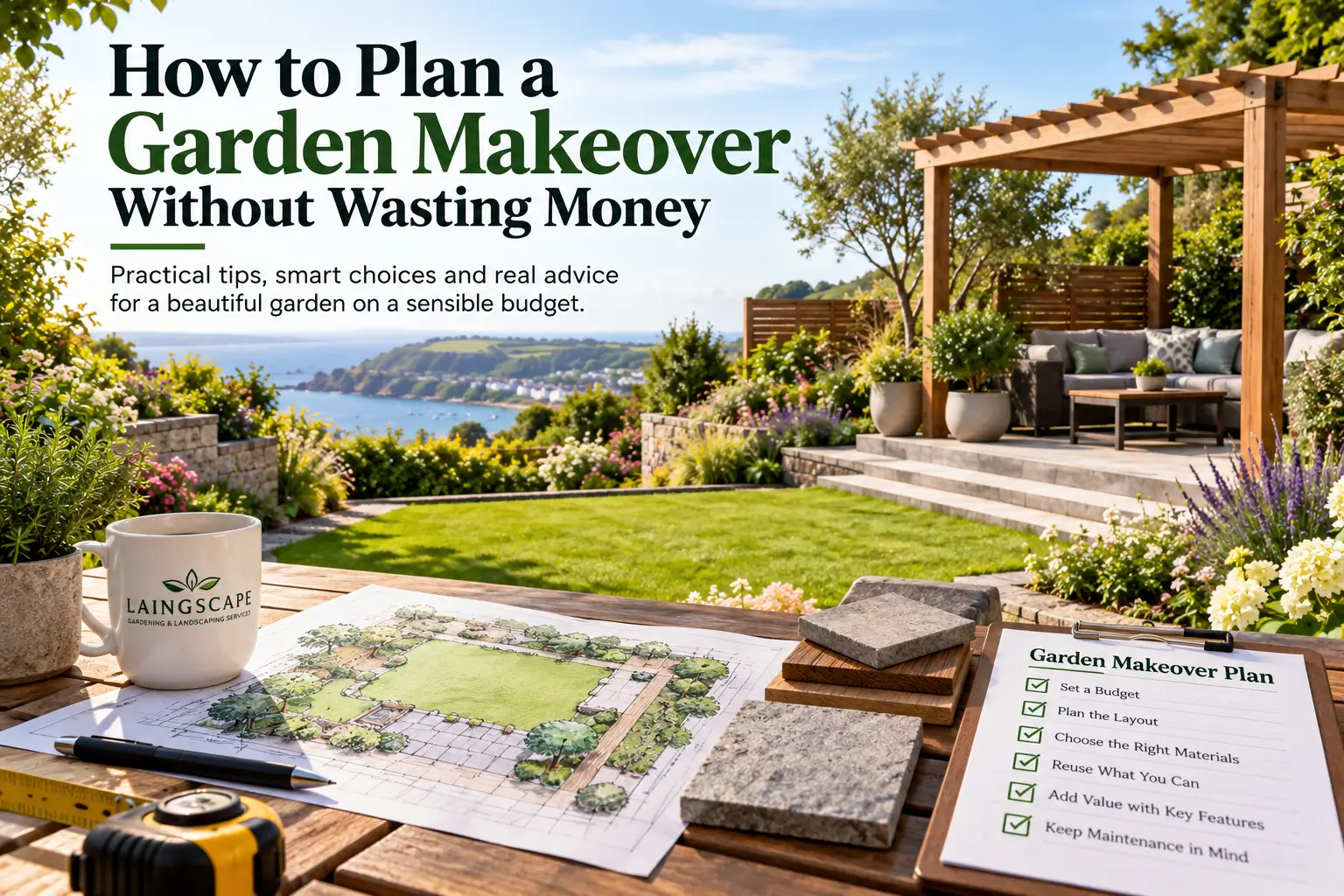
Create a simple plan showing:
- The house and garden boundaries
- Existing patios and paths
- Trees and established planting
- Fencing and gates
- Sheds or garden buildings
- Drain covers and other fixed features
- Areas of sun and shade
- Proposed seating, lawn and planting areas
You do not necessarily need specialist design software. A carefully measured sketch can help you test different layouts before any physical work begins.
The RHS notes that creating a scale plan can help homeowners order the correct quantities of materials and avoid costly changes once work has started.
For wider professional support, see About Laingscape and Laingscape Services.
Decide What You Actually Need From the Garden
A garden should work for the people using it. Before choosing colours, paving or plants, think about how you want to use the space.
Ask yourself:
- Do you need more outdoor seating?
- Is the lawn important for children or pets?
- Would better privacy make the garden more enjoyable?
- Is the current layout difficult to access?
- Does the garden require too much maintenance?
- Are drainage or waterlogging issues affecting the space?
- Would a pergola create a useful outdoor living area?
- Do you need more practical storage?
Your answers should influence the design.
For example, if you rarely have time for gardening, a layout that requires extensive lawn care and frequent pruning may not be the best investment. The RHS recommends considering maintenance requirements during the design stage rather than trying to solve them afterwards.
Set a Realistic Garden Makeover Budget
Once you know what you want to achieve, decide how much you are comfortable investing.
A useful approach is to divide the project into three categories:
Essential work
Drainage, ground preparation, structural repairs, unsafe fencing and other work that needs addressing first.
Priority improvements
Patios, lawns, fencing, planting areas, decking or other features that will make the biggest difference to how the garden is used.
Optional extras
Decorative features, additional planting, upgraded finishes and accessories that can be added later.
This approach gives you flexibility. If the first quotation is higher than expected, you can review the optional elements without compromising essential work.
For a broader transformation, Landscaping Cornwall can be considered when several garden elements need to work together.
Prioritise Groundwork Before Decorative Features
When considering How to Plan a Garden Makeover Without Wasting Money, the order of work matters just as much as the budget.
Drainage, ground levels, access and structural work should normally be addressed before delicate planting or finishing touches.
Imagine installing a new lawn and then discovering that heavy construction work needs to cross the same area. The lawn may have to be repaired or replaced.
A sensible sequence can be:
- Assess and clear the garden.
- Address drainage and ground-level issues.
- Complete major hard landscaping.
- Install fencing and fixed garden structures.
- Prepare soil and planting areas.
- Install or renovate the lawn.
- Complete planting and decorative features.
- Establish a suitable maintenance routine.
Planning the sequence properly can help protect the work you have already paid for.
Reuse What You Can
A garden makeover does not mean everything has to be removed.
Look carefully at existing features before deciding what goes. Healthy shrubs can sometimes be moved. Sound fencing may only need repair or treatment. Existing paving may be reusable, while garden furniture, containers and decorative features may still have plenty of life left.
The RHS also recommends considering what can be salvaged from an existing garden rather than automatically replacing everything.
This is particularly useful when working with a limited budget.
Spend More on the Things That Matter
Saving money does not mean choosing the cheapest option for every part of the project.
Some elements are difficult and expensive to correct later. Ground preparation, drainage, structural work and major hard landscaping deserve careful attention.
For example, a poorly prepared base beneath a patio can create problems that are far more expensive to correct than doing the groundwork properly at the beginning.
On the other hand, you can often introduce plants gradually. Smaller plants may establish over time, allowing you to create a mature-looking garden without buying everything at once.
The same principle applies to decorative features. A simple, well-planned garden can often look more effective than one filled with unnecessary additions.
Choose Plants for Your Actual Garden
Plant selection should be based on the conditions of your garden rather than simply choosing plants that look attractive online.
Consider:
- Soil type and condition
- Sunlight and shade
- Wind exposure
- Available moisture
- Mature plant size
- Seasonal interest
- Maintenance requirements
This is especially important in Cornwall, where individual gardens can experience different levels of wind, rain, exposure and coastal influence.
Choosing plants that suit the conditions can reduce the risk of replacing unsuccessful planting later.
Think About Long-Term Maintenance
A successful makeover should make your garden easier to enjoy, not create a completely new list of jobs.
Think honestly about how much time you have available for mowing, weeding, pruning, hedge cutting and seasonal work.
A low-maintenance approach might include:
- Sensibly sized lawn areas
- Suitable perennial planting
- Accessible borders
- Practical pathways
- Durable hard landscaping
- Plants suited to the site
- A manageable maintenance routine
If regular upkeep is difficult because of work or family commitments, professional maintenance can help protect your investment.
Laingscape provides Seasonal Garden Maintenance Cornwall as well as local maintenance services for different areas of Cornwall, including Garden Maintenance Falmouth, Garden Maintenance in Newquay and Garden Maintenance in Truro.
Consider a Phased Garden Makeover
You do not have to transform the entire garden at once.
If your budget is limited, divide the project into sensible stages. For example, you could deal with drainage and hard landscaping first, then improve planting and lawn areas later.
This approach can also give you time to understand how the garden behaves throughout the year before making further decisions.
The RHS similarly advises taking time to assess an established garden and, where appropriate, breaking larger changes into manageable stages.
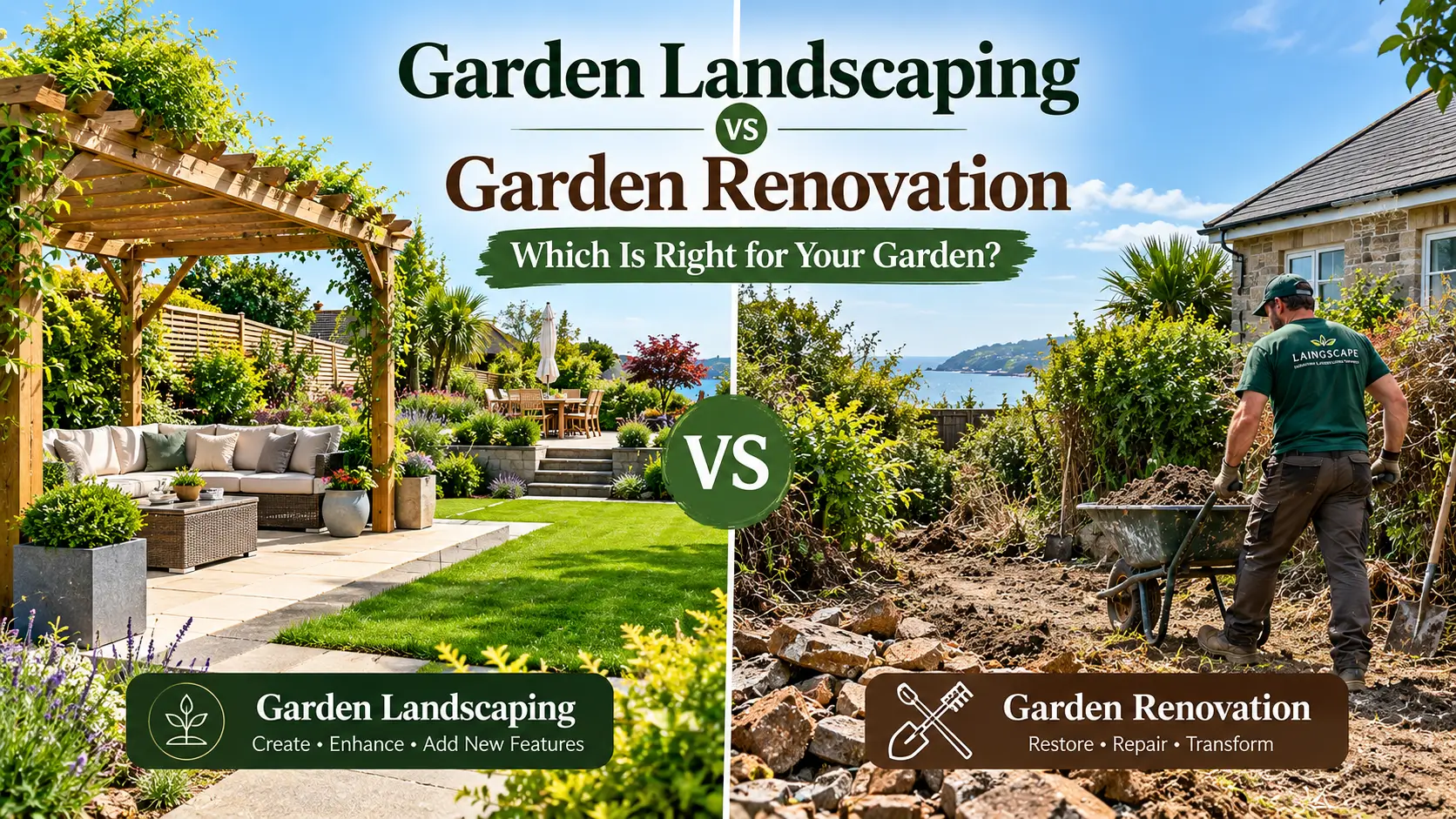
For inspiration, our related article Garden Landscaping vs Garden Renovation: Which Is Right? explains how different approaches can suit different garden problems.
You may also find How to Manage an Overgrown Garden Without Starting Again useful if your garden needs significant improvement but does not necessarily need to be cleared completely.
Choose Garden Features That Add Real Value
Once the essentials are covered, think carefully about the features that will improve how you use the garden.
A pergola, for example, can create a defined outdoor seating or dining area. Laingscape provides Pergola Installation Cornwall and Pergola Installation Truro.
If you already have a clear idea of the garden structure you want, it is worth considering how that feature will connect with the rest of the design rather than adding it as an afterthought.
Compare Contractors Carefully
If professional work is required, do not automatically choose the lowest quotation.
Ask what is included, how the work will be carried out, what preparation is required and whether clearance or waste removal is included.
The RHS recommends considering a contractor’s experience, references, photographs and relevant qualifications or insurance where appropriate.
For homeowners researching local contractors, independent feedback can also provide useful context. Laingscape’s Google Business Profile and Trustpilot reviews can be considered alongside the company’s experience, services and previous work.
You can also explore Garden Maintenance St Austell and Garden Maintenance St Mawes if you are looking for area-specific garden maintenance.
Use Professional Help Where It Makes Sense
DIY can be a good option for smaller improvements, but some garden work requires proper planning and practical experience.
Professional support can be particularly useful for:
- Complex ground preparation
- Drainage improvements
- Patios and hard landscaping
- Garden structures
- Major fencing projects
- Large-scale lawn installation
- Complete garden renovations
Laingscape has more than 20 years of gardening and landscaping experience across Cornwall, helping homeowners plan and maintain practical outdoor spaces.
For commercial properties, Commercial Garden Maintenance in Cornwall provides a separate maintenance service.
You can also read Garden Maintenance for Busy Homeowners: What Should You Outsource? before deciding which tasks are worth handling yourself.
Helpful Garden Planning Resources
Before starting major work, it is worth checking reliable sources rather than relying solely on social media inspiration.
The RHS garden planning guidance provides practical advice on measuring and planning a garden, while its budget-friendly garden advice covers ways to make an outdoor space more affordable.
If your project involves structures or other work that may have planning implications, check current guidance from GOV.UK planning guidance rather than assuming that every project has the same requirements.
Get Professional Help With Your Cornwall Garden
If you are still deciding How to Plan a Garden Makeover Without Wasting Money, you do not have to work everything out alone.
Laingscape can discuss your ideas, assess the garden and help you understand which improvements may be worth prioritising.
With more than 20 years of experience, local Cornwall knowledge and a practical approach to landscaping and garden maintenance, our team works with homeowners to create outdoor spaces that are useful, attractive and manageable.
Whether you need regular maintenance, a new lawn, fencing, a pergola or a wider garden transformation, we offer free, no-obligation quotations.
For more advice, see Best Garden Maintenance Schedule for Cornwall Homes, Seasonal Garden Maintenance Tips Cornwall and Garden Maintenance Checklist for Homeowners.
Ready to Improve Your Garden?
If your Cornwall garden needs professional attention, contact Laingscape to discuss your plans.
Call +44 7988 759149 or email oliver@laingscape.co.uk. You can also use our Contact Laingscape page to arrange a conversation and request a free, no-obligation quotation.
Homeowners can also review Laingscape’s Google Business Profile and independent Trustpilot reviews before making a decision.
Conclusion
The key to How to Plan a Garden Makeover Without Wasting Money is not simply spending less. It is spending deliberately.
Start by assessing what you already have, decide how the garden needs to function, set realistic priorities and deal with practical problems before decorative features.
You do not need to complete everything at once. A phased approach can make a large project more manageable while allowing you to see what works as the garden develops.
With careful planning and the right professional support where needed, you can create a garden that looks better, works harder and makes better use of your investment.
FAQs
How do I start planning a garden makeover on a budget?
Start by assessing the existing garden, listing essential repairs and deciding how you want to use the space. Then set a realistic budget and prioritise practical work before decorative additions.
What is usually the most expensive part of a garden makeover?
Costs vary between properties, but major ground preparation, drainage, retaining structures and hard landscaping can have a significant effect on the total project cost.
Should I replace my existing lawn?
Not necessarily. If the lawn is generally healthy, renovation may be more economical than complete replacement. Persistent drainage, compaction or poor growth may indicate that replacement is more appropriate.
Is it cheaper to landscape a garden in stages?
Phasing can make the cost easier to manage and spread spending over time. It can also allow you to understand how the garden behaves before making later decisions.
How can I avoid wasting money on plants?
Choose plants according to the garden’s soil, light, moisture, exposure and available space. Consider mature size and maintenance requirements rather than buying purely for appearance.
Should I hire a professional landscaper?
Professional help can be useful for complex groundwork, drainage, hard landscaping and larger transformations. Compare experience, scope of work and quotations rather than price alone.
How can I make my garden easier to maintain?
Use a practical layout, manageable lawn areas, suitable plants, durable features and accessible borders. A regular maintenance plan can also prevent small problems becoming expensive ones.
Can Laingscape help with a complete garden makeover?
Yes. Laingscape provides gardening and landscaping services across Cornwall, including garden maintenance, turf laying, fencing, patios, decking, pergolas and wider landscaping.
Does Laingscape offer free garden quotations?
Yes. Laingscape offers free, no-obligation quotations. You can discuss your requirements and receive practical advice based on your property and planned work.
Where does Laingscape provide garden services?
Laingscape serves Mid Cornwall and surrounding areas, including Truro, Newquay, Falmouth, St Mawes, St Austell and nearby locations.