Skip to content
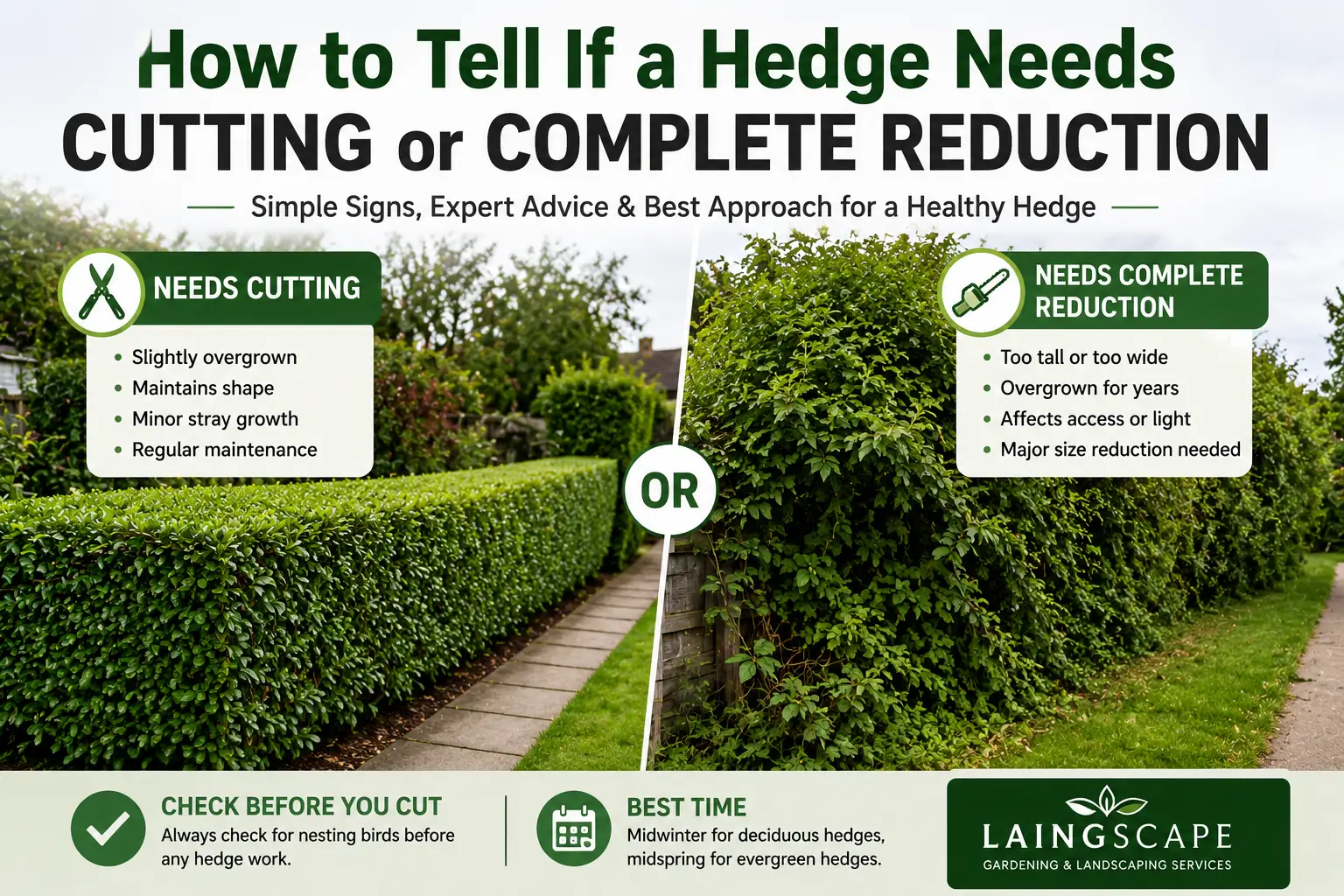
An overgrown hedge can creep up on you. One season it looks slightly untidy; before long, branches are extending over paths, blocking light and taking up far more garden space than intended.
But what happens if you leave an overgrown hedge untreated? The answer depends on the hedge species, its location, how long it has been neglected and how aggressively it is growing.
Some hedges can be reduced successfully after years of neglect. Others, particularly certain conifers, may not recover well from severe cutting. Meanwhile, a hedge growing along a boundary can create practical problems for neighbouring gardens, paths and access.
Regular maintenance is therefore about more than appearance. It can help keep hedges healthy, manageable and suited to the space around them.
Why Do Hedges Become Overgrown?
Hedges are living plants, so they naturally continue growing unless they are regularly managed.
A hedge can become overgrown when it has not been trimmed for several seasons, when the wrong plant has been selected for the available space, or when routine garden maintenance has been overlooked.
Common reasons include:
- Busy homeowners having little time for garden work
- Rapid growth during spring and summer
- Large hedges becoming difficult to cut safely
- Previous owners neglecting the garden
- Plants being allowed to grow beyond their intended size
- Lack of regular pruning knowledge
The RHS explains that established hedges generally need regular trimming to keep them dense, neat and within their intended boundaries.
What Happens If You Leave an Overgrown Hedge Untreated?
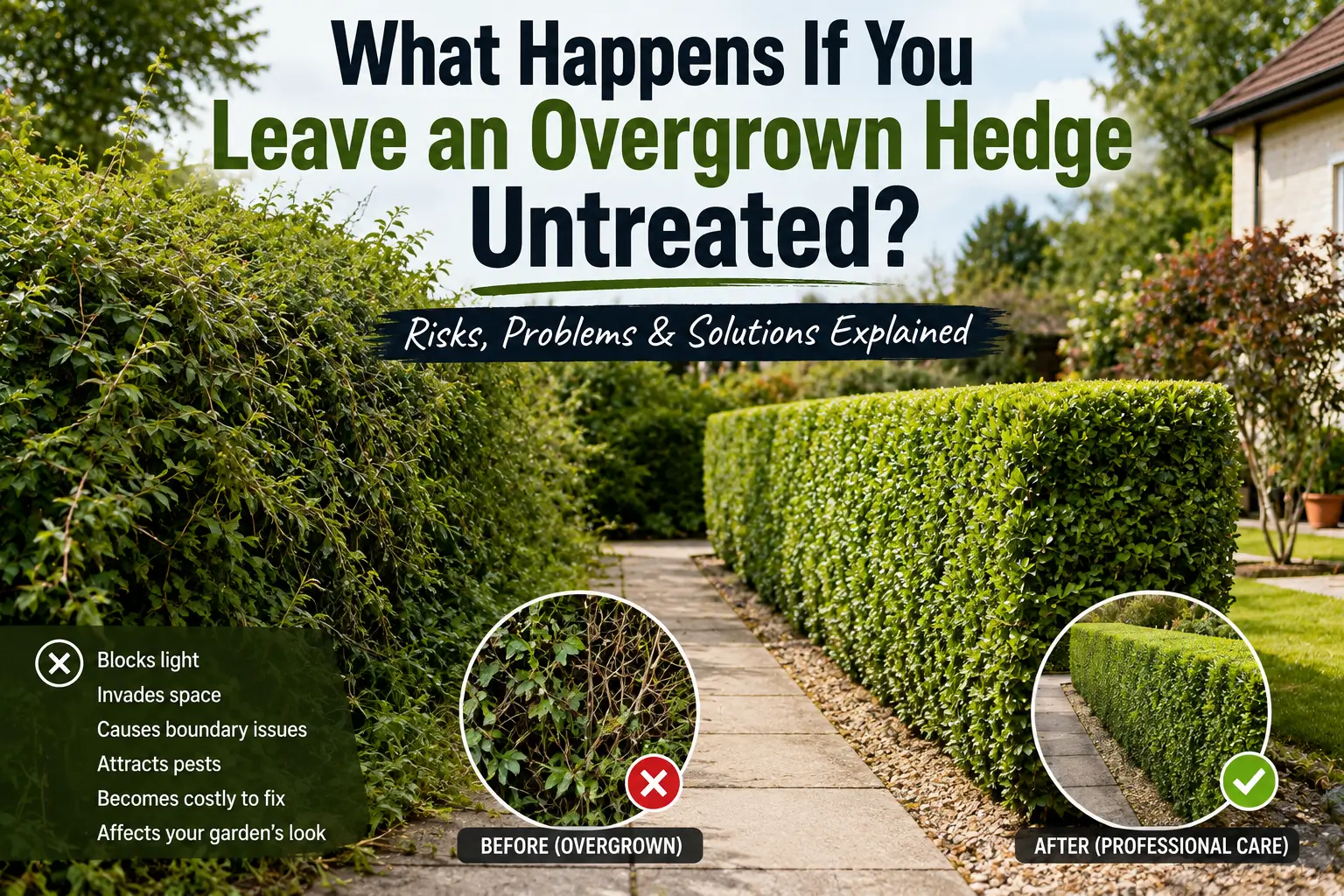
The most obvious result is that the hedge becomes larger, but the consequences can go much further.
As growth continues, an unmanaged hedge can become wider, taller and increasingly woody. This may reduce usable garden space and make future maintenance more difficult.
You may also notice:
- Paths becoming narrower
- Grass and borders receiving less light
- Branches extending over boundaries
- Windows or garden views becoming blocked
- Lower sections becoming thin
- Trimming becoming more difficult
- The hedge becoming harder to restore
A hedge that is manageable today can therefore become a much larger maintenance project if it is ignored for several years.
Overgrown Hedges Can Reduce Light
One of the most noticeable problems is excessive shade.
A tall, dense hedge can block sunlight from reaching lawns, borders, patios and neighbouring areas. This can affect plants that need good levels of light to grow well.
The RHS notes that dense hedges can be useful for blocking unwanted views, noise and pollution, but an overly large hedge can become problematic where it blocks too much light or becomes overbearing.
For example, imagine a narrow garden where a mature hedge has gradually increased in height and width. What once provided useful privacy may eventually make the garden feel darker and smaller.
Reducing it to a sensible size can make the whole outdoor space feel more open.
Your Garden May Start Losing Valuable Space
Hedges can occupy surprisingly large amounts of space once they are left unchecked.
A hedge planted along a garden boundary may initially be relatively narrow. Over time, however, side growth can extend well into the lawn or border.
This is particularly noticeable in smaller gardens.
A few extra centimetres of growth may not seem important, but repeated growth over several years can turn a narrow boundary into a substantial strip of vegetation.
Careful trimming helps maintain the balance between privacy and usable garden space.
Overgrown Hedges Can Affect Boundaries
Boundary hedges require particular attention because growth can extend beyond the property line.
Branches may overhang paths, neighbouring gardens or other areas, potentially creating disagreements if the hedge is not managed responsibly.
The RHS provides guidance on nuisance and overgrown hedges and explains that certain high-hedge situations can become a neighbour-related issue, particularly where excessive height affects reasonable enjoyment of a property.
This doesn’t mean every tall hedge is a legal problem. However, it is sensible to keep boundary vegetation under control and communicate with neighbours where necessary.
If you’re unsure about a boundary or legal issue, seek appropriate local or professional advice rather than assuming that every hedge is subject to the same rules.
Can an Overgrown Hedge Still Be Saved?
Often, yes—but it depends heavily on the plant.
Many established hedges can be reduced and brought back into a more manageable shape. However, severe pruning should not automatically be treated as a quick fix.
The RHS advises that drastic renovation involving a reduction of more than half the hedge’s height or width may be better carried out gradually over two or three years.
This is important because some plants respond much better to hard pruning than others.
Deciduous hedges can often respond well to renovation, while many conifers do not regenerate from old, bare wood. Yew is an important exception.
If you don’t know what species your hedge is, identifying the plant before undertaking major cutting is a sensible first step.
When an Overgrown Hedge May Need More Than Trimming
Sometimes trimming alone isn’t the best solution.
A neglected hedge may have:
- Large areas of bare wood
- Weak or damaged branches
- Poor growth at the base
- Excessive width
- Severe imbalance
- Plants that have outgrown the location
In these situations, renovation, staged reduction or replacement may be more appropriate.
For example, an old conifer hedge that has become extremely wide and bare inside may not respond well to cutting deeply into old wood. Replacing it with a more suitable hedge or boundary solution could ultimately produce a better garden.
The right decision should be based on the plant’s condition rather than simply how much it has grown.
Don’t Forget Wildlife When Cutting a Hedge
Hedges are valuable wildlife habitats. Birds can use dense vegetation for nesting, while flowering and berry-producing hedges can provide food for insects and birds.
This means hedge maintenance needs to be carried out responsibly.
The RHS advises checking carefully for active bird nests before trimming. Under the Wildlife & Countryside Act 1981, it is an offence to damage or destroy a wild bird’s nest while it is in use or being built.
For certain agricultural hedgerows, additional cutting restrictions also apply. GOV.UK states that relevant hedgerows covered by its management rules must not generally be cut or trimmed between 1 March and 31 August, subject to specified exemptions. Those rules do not apply in the same way to private garden boundaries.
For any hedge, check carefully for nesting birds and postpone work where active nests are present.
How Regular Hedge Cutting Prevents Problems
The easiest way to deal with an overgrown hedge is usually to avoid allowing it to become seriously overgrown in the first place.
The ideal frequency depends on the species and the style of hedge.
According to the RHS, informal hedges may often need trimming around once a year, while formal hedges can require one, two or even three cuts during the growing season depending on the plant.
Regular maintenance helps control:
- Height
- Width
- Shape
- Density
- New growth
It also makes each individual cutting job more manageable.
Instead of attempting to remove years of growth in one session, regular light trimming keeps the hedge closer to its desired size.
Signs Your Hedge Needs Professional Attention
Not every hedge requires a professional gardener. Small, manageable hedges can often be maintained by homeowners with the right equipment and knowledge.
However, professional help may be sensible when:
- The hedge is very tall
- Thick branches require specialist equipment
- The hedge is close to a road or public path
- Access is difficult
- Large quantities of waste need removing
- The hedge has been neglected for several years
- You’re unsure how severely it can be reduced
- Safety is a concern
Trying to tackle a large hedge without suitable equipment can create unnecessary risks.
A professional assessment can also help determine whether the hedge needs routine trimming, staged reduction or a different approach altogether.
Professional Hedge Cutting in Cornwall
At Laingscape, we provide professional hedge cutting and garden maintenance services across Cornwall, helping homeowners keep outdoor spaces tidy, practical and manageable.
Our wider garden maintenance services include hedge trimming and reduction, seasonal pruning, weed control, brushcutting, strimming and overgrown garden clearance.
With more than 20 years of hands-on experience, we understand that every garden is different. We consider the condition of the hedge, surrounding garden and the level of maintenance required before recommending an approach.
For customers who need ongoing care, regular hedge work can also be included within a wider garden maintenance schedule.
You can explore our Hedge Cutting Services, Garden Maintenance, and Services pages to learn more about the work we provide.
Need Help With an Overgrown Hedge?
If you’re wondering what happens if you leave an overgrown hedge untreated, the simple answer is that the problem rarely becomes easier with time.
An unmanaged hedge can become larger, harder to cut, more expensive to restore and potentially more disruptive to the surrounding garden.
Laingscape can assess your hedge and help you understand what practical options are available, whether that means routine trimming, reduction, staged renovation or wider garden maintenance.
With over 20 years of experience, we provide a straightforward local service across Cornwall.
Call: 07988 759149
Email: oliver@laingscape.co.uk
Address: Four Winds, Zelah, Truro TR4 9JD, United Kingdom
You can also use the relevant internal service pages to learn more about Garden Maintenance, Weed Control, Garden Clearance, and Landscaping.
Frequently Asked Questions
What happens if you leave an overgrown hedge untreated?
It can become taller, wider and increasingly woody, potentially blocking light, reducing garden space and becoming more difficult to maintain or restore.
Can an overgrown hedge be cut back hard?
Some hedge species tolerate significant reduction, but others do not regenerate well from old wood. The appropriate method depends on the plant and its condition.
How often should a hedge be trimmed?
It depends on the species and desired appearance. Some informal hedges may need annual trimming, while formal hedges can require more frequent cutting during the growing season.
Can an overgrown hedge damage my garden?
An excessively large hedge can reduce light and take up valuable garden space. If it grows near structures, paths or drainage, other considerations may also need to be assessed.
Can I cut my neighbour’s hedge?
Don’t assume you can simply cut everything that crosses a boundary. Boundary responsibilities can vary, so communicate with the neighbour and seek appropriate advice if you’re unsure.
When should an overgrown hedge be renovated?
The suitable timing depends on the hedge species. The RHS advises different renovation periods for deciduous and evergreen hedges and recommends staged reduction for drastic renovation.
Is it legal to cut a hedge when birds are nesting?
You must not damage or destroy an active wild bird’s nest. Always check carefully for nesting birds before starting hedge work and postpone cutting if an active nest is present.
Are all tall hedges considered a legal problem?
No. A tall hedge is not automatically unlawful. Specific high-hedge rules can apply in certain circumstances, particularly where a qualifying hedge affects a neighbour’s reasonable enjoyment of their property.
Should I remove an overgrown hedge or reduce it?
That depends on the species, condition, location and how severely it has grown. Many hedges can be reduced, but some may be better replaced if they cannot recover properly from hard pruning.
Can Laingscape maintain an overgrown hedge regularly?
Yes. Laingscape provides hedge trimming and reduction as part of its garden maintenance services across Cornwall, helping keep hedges manageable and gardens well presented.
Conclusion
So, what happens if you leave an overgrown hedge untreated? Over time, it can become more difficult to manage, take valuable space from your garden, block light and create problems around boundaries and access.
The good news is that an overgrown hedge does not always need to be removed. With the right assessment and pruning approach, many hedges can be brought back under control.
Regular maintenance is usually the simplest long-term solution. By keeping growth within sensible limits and choosing the right pruning approach for the plant, you can maintain privacy and structure without allowing the hedge to dominate the garden.
For homeowners across Cornwall, professional hedge cutting can take the hard work out of maintaining large or difficult hedges while helping keep your garden attractive, safe and manageable throughout the year.